
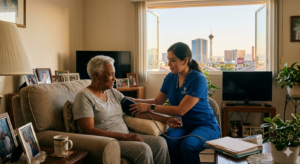
Falls at home are rarely just accidents. They tend to follow patterns that go unnoticed until something finally gives. With the right mix of Skilled Nursing and therapy services, those patterns can be interrupted early, making daily movement safer without taking away independence.
What This Guide Will Cover:
This guide looks at why falls actually happen in a home setting, how therapy services address the underlying issues, and what changes make a real difference in day-to-day safety. It also explains how a coordinated care approach keeps everything working together over time.
Understanding Why Falls Happen at Home
Most falls have a backstory. It might be a slight loss of balance that shows up when turning too quickly, or legs that do not feel as steady by the end of the day. Sometimes it is hesitation on stairs or the need to grab onto furniture more often than before. At a First Patient Care Clinic, we pay attention to these small signals because they tend to show up long before a serious fall. Ignoring them is easy. Addressing them early is what changes outcomes.
Why the Home Environment Plays a Critical Role
There is a difference between talking about safety and actually seeing how someone moves through their own space. Receiving in-home health care in Las Vegas, NV, allows us to notice details that would never come up in a clinical setting. The way light hits a hallway at night, how far the bed sits from the bathroom, or even how a favorite chair is positioned can all shape risk. These are not dramatic hazards, but they add up. When care happens at home, the solutions tend to be practical because they are based on what is really there.
How Physical and Occupational Therapy Improve Safety
Physical Therapy tends to get most of the attention, and for good reason. Strength, balance, and coordination are what keep people upright in the first place. When those start to decline, even slightly, everyday movement becomes less predictable. We work on rebuilding that stability in ways that carry over into real life, not just exercises done in isolation. Occupational Therapy fills in the gaps that strength alone cannot fix. It looks closely at how tasks are done, whether it is getting dressed or stepping into a shower, and makes adjustments that reduce strain and lower risk without turning routines upside down.
The Role of Speech Therapy and Case Management
Speech Therapy is not always the first thing people associate with fall prevention, but it should not be overlooked. Changes in cognition can affect judgment, timing, and awareness, all of which play a role in staying safe. When those areas are supported, people tend to move with more awareness of their surroundings. Case Management keeps everything from drifting off course. It is the steady thread that connects each part of care, making sure progress is tracked and nothing important gets missed along the way.
Practical Fall Prevention Strategies We Use
At First Patient Care Clinic in Las Vegas, the most effective strategies are often the simplest ones, the kind that fit naturally into a person’s routine without making life feel clinical or restricted. Some of the changes we focus on include:
- Improving lighting in areas that tend to be used early in the morning or late at night
- Clearing walkways and removing items that quietly become tripping points
- Practicing safe ways to sit, stand, and shift weight during daily movement
- Using assistive devices, the right way instead of just having them nearby
- Building routines that reduce rushing, especially during times of fatigue
None of these adjustments is complicated on its own, but together they create a kind of consistency that the body can rely on, and that consistency is what reduces risk.
Supporting Independence While Reducing Risk
There is a common assumption that preventing falls means limiting activity, but that usually does more harm than good. People need to move. The goal is to make that movement steadier and more predictable, not to scale it back. With the right support in place, many people actually become more confident moving around their homes, not less. That shift matters because confidence affects how people walk, react, and carry themselves throughout the day.
Conclusion
The fall prevention activity at Stellar Care Home Health is viewed as evolving, not something fixed and left to be forgotten. Minor variations in strength, balance, or awareness can turn into risk over time, hence the importance of being ahead of the changes. Unless you have already begun to observe the slightest variations in the way you or someone dear to you moves about at home, now is the time to listen. Contact us to make arrangements to keep daily life as stable, secure, and self-sufficient as possible.
FAQs
- How does a Home Health Care Provider help prevent falls at home?
We assess how you move in your own space and address risks through Skilled Nursing and therapy services. The focus is on improving strength, balance, and daily safety. - When should someone consider Home Health Care for fall prevention?
If you notice changes in balance, slower movement, or increased reliance on support while walking, it is time to act. Early care helps reduce the risk before a fall happens. - What role does Physical Therapy play in fall prevention?
Physical Therapy improves strength, coordination, and stability, which are essential for safe movement. It helps reduce the chances of losing balance during daily activities. - Can Occupational Therapy make everyday tasks safer at home?
Yes, Occupational Therapy focuses on how daily activities are performed and makes practical adjustments. This helps reduce strain and lowers the risk of accidents. - How does Case Management support long-term fall prevention?
Case Management keeps your care plan organized and ensures all services work together. It helps track progress and adapt care as your needs change over time.